Copy trading lets one account’s trades be replicated across many followers. For a brokerage, that multiplies both revenue and risk: a single strategy can create concentrated exposure within seconds, and any weakness the provider exploits is repeated across every copying account.
Most copy-trading activity is legitimate. The aim of monitoring is to spot the specific patterns that turn the mechanism against the brokerage or its clients, and to measure them on the whole network rather than on the provider alone.
Watch the exposure a provider creates
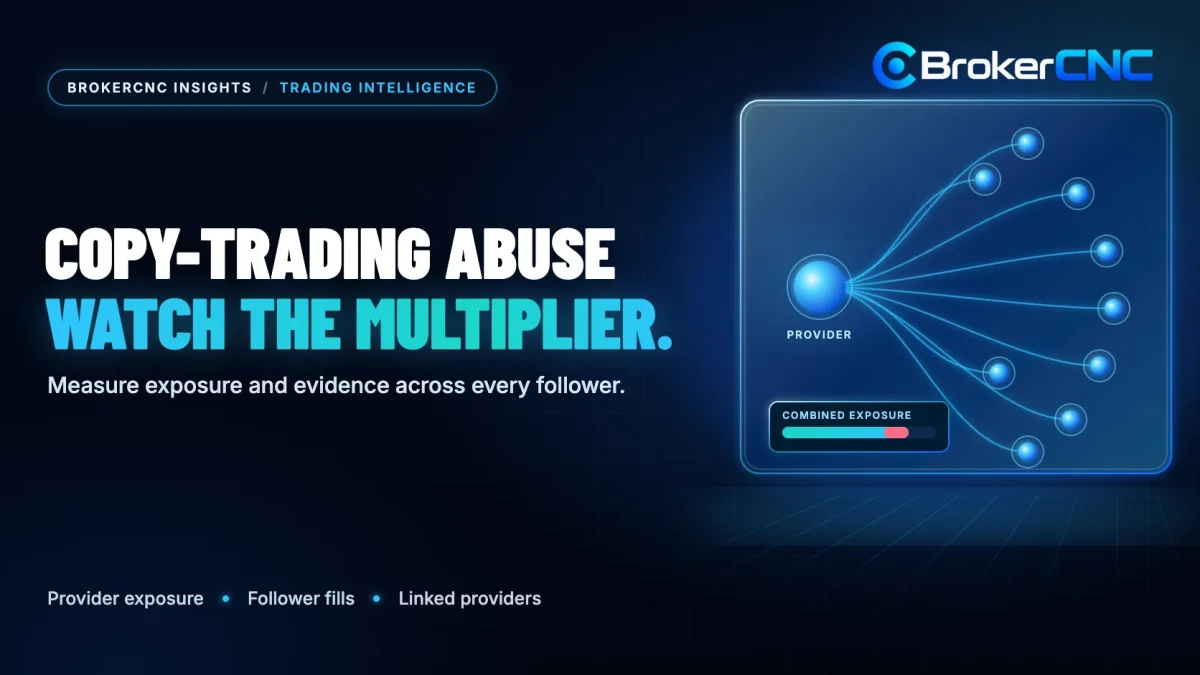
Treat a popular strategy provider as a source of correlated flow. When the provider opens a position, every follower opens the same direction at almost the same time. Monitor the combined exposure by symbol and the share that sits on the B-Book, rather than reviewing followers individually.
Set concentration limits that reflect this. A provider whose followers together hold a large share of net exposure in one instrument may warrant different routing or hedging, even if no rule is being broken.
Hundreds of followers copying one provider behave like one large account. Exposure and routing decisions should treat them that way.
Check whether toxic patterns are being amplified
If a provider’s results rely on latency, stale quotes or news-time execution, copying spreads that advantage across many accounts. Review the provider with the same evidence standards used for any toxic-flow case, then measure the effect across the followers.
Followers often receive worse fills than the provider because their orders arrive later. A large gap between provider and follower outcomes can indicate that the strategy depends on execution speed that followers do not have.
Look for manipulated provider statistics
Copy platforms rank providers on performance, so there is an incentive to make statistics look better than the trading supports. Patterns to review include several provider accounts run by the same person with only the winners promoted, hedging between related provider accounts, and very small, low-risk trades used to build a track record before changing behaviour.
The linked-account guide explains how to establish whether provider accounts are related before drawing conclusions.
Review commission and rebate flows
Where providers earn performance fees or volume-based commission, compare those payments with the trading behind them. Self-copying between related accounts, or churned volume designed to generate fees, follow the same review logic as IB abuse: map the relationships, follow the funds and measure the group result.
Respond at the right level
- Measure combined follower exposure by symbol and book.
- Apply normal toxic-flow evidence standards to providers.
- Compare provider and follower execution outcomes.
- Check whether provider accounts are related.
- Choose a response at provider, follower or routing level.
Responses can apply to the provider, to the followers or to the routing of the copied flow. Moving the strategy’s volume to the A-Book, adjusting execution, delisting a provider or applying the platform’s terms are different decisions with different evidence requirements. Record which one was taken and why.
BrokerCNC brings these views together: real-time exposure monitoring shows the concentration a provider creates, while Toxic Trading Detection and Linked Account Detection supply the evidence behind each case.
Common copy-trading questions
Is copy trading risky for brokers?
It concentrates flow. The risk is manageable when exposure is measured across all followers and routing reflects the provider’s profile.
Why do followers get different results from the provider?
Orders are replicated after the provider’s trade, so followers can receive different prices, especially in fast markets or with strategies that depend on speed.
See the workflow in BrokerCNC.
Discuss your MT4/MT5 servers, operating priorities and the evidence your team needs.
Book a Live Demo →