
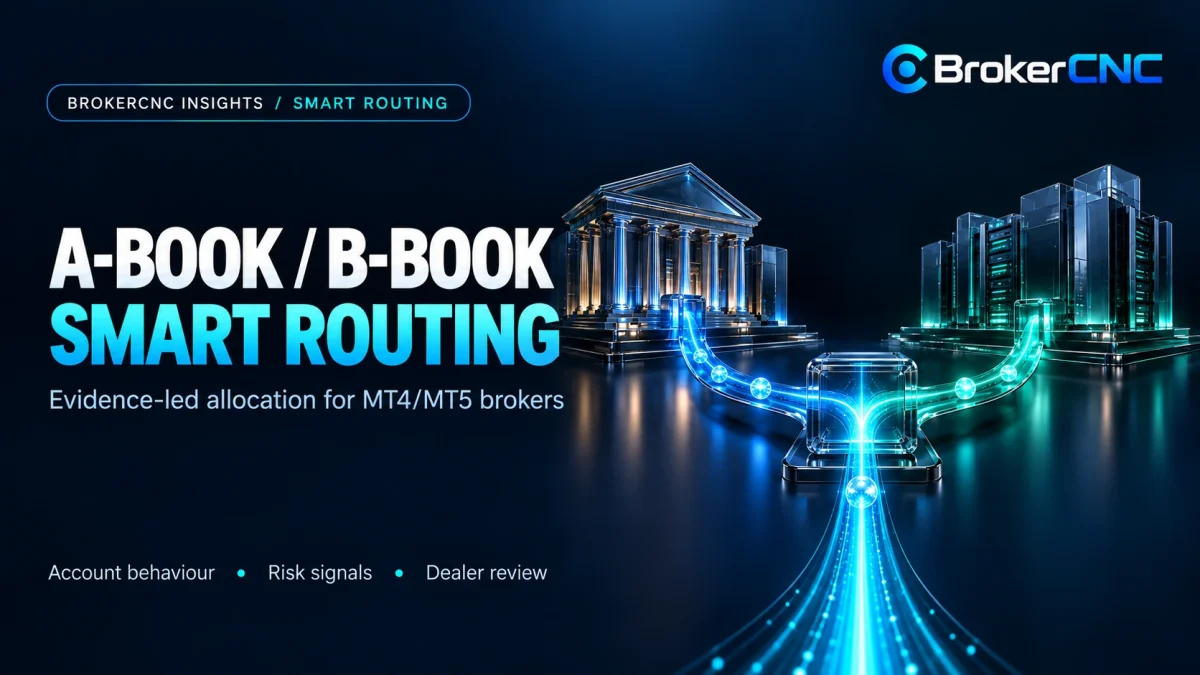
A-Book and B-Book smart routing helps a forex brokerage decide which trading risk to retain and which flow to pass to liquidity providers. A useful recommendation combines account behaviour, current exposure, execution evidence and the economics of each route. It should also explain its reasoning to the dealing team.
The decision is more demanding than separating winning and losing accounts. Historical client profit is one input, not a complete assessment of future risk. This guide describes an operating framework for reviewing routing recommendations across MT4 and MT5.
Start with the brokerage’s risk objective
Define what the routing policy is meant to control: symbol concentration, directional exposure, exposure to particular strategies, or the cost of external execution. Set the scope and the review period before comparing routes. A recommendation for one account can have a different effect when considered alongside the rest of the book.
Define A-Book and B-Book operationally within your infrastructure. An instruction to route externally is not proof that the external hedge was executed. Your review should distinguish configured allocation, actual fills and any residual exposure.
Build a profile that explains the flow
Start with volume, holding time, turnover, realised and unrealised results, instrument mix and the distribution of activity through the session. Compare similar periods and account for changes in trading style. A small sample of profitable trades should not carry the same weight as a consistent, well-observed pattern.
Connect the profile to execution records where available. Review price outcomes, rejected or partially filled requests and the conditions around the activity. Preserve the original server and login identifiers so accounts from different environments are not confused.
Connect behaviour to exposure and linked-account evidence
Review suspicious patterns alongside the account profile. Repeatedly coordinated positions, shared infrastructure and unusually concentrated activity can explain risk that is difficult to see account by account. These signals support an investigation; they do not establish abuse on their own.
Consider the combined exposure of related accounts before suggesting an allocation. Routing one account externally while retaining offsetting flow elsewhere can change the book differently from routing a whole group. The reviewer needs to see that context.
Use the linked-account detection guide for the evidence behind network relationships, and the exposure monitoring guide for the portfolio view.
Compare routes on a consistent economic basis
Model retained market risk separately from markup, commissions, swaps, rebates and execution costs. Compare all routes over the same horizon, currency and volume assumptions. Show the assumptions next to the recommendation instead of presenting a single forecast as a guaranteed result.
A dealing desk might compare full external routing, a partial allocation and full internal retention. Each scenario should state the projected exposure, assumed liquidity and bridge costs, and the market-risk assumptions behind the result. The preferred route can change when those assumptions change.
Back-test proposed rules against several conditions, including unusually active sessions and concentrated positions. Monitor whether the expected reduction in exposure actually occurred after execution. Review modelled outcomes separately from realised revenue.
Keep approval and exceptions visible
Define which recommendations require dealer approval, who can authorise an exception and how decisions are recorded. Preserve the supporting snapshot, recommendation time, policy version and effective allocation time. If the route changes while a position remains open, retain its earlier history.
- Confirm the account, server and current allocation.
- Review the evidence and the effect on the wider book.
- Check execution and cost assumptions.
- Record the decision, its owner and any expiry or review date.
- Reconcile the applied route against actual execution.
What to ask in a smart-routing software demo
Ask the provider to explain one recommendation from source data to dealer review. Can the reviewer see the account history, linked signals, alternative allocations and estimated book impact? Can they identify missing data and understand why the model reached its conclusion?
The BrokerCNC Smart Routing demo brings account behaviour, connected risk signals and allocation recommendations into one workflow. Read A-Book and B-Book revenue and costs before evaluating its economic assumptions. To discuss your routing setup, arrange a live BrokerCNC demo.
Common smart-routing questions
Should every profitable account be routed to A-Book?
Profit alone does not explain the risk or economics of a route. Review the account’s activity, sample size, execution context and contribution to the whole book before making a decision.
Is smart routing the same as automatic execution?
No. An analytical recommendation and an executed routing change are separate events. Confirm the approval process and integration behaviour for your particular setup.
See the workflow in BrokerCNC.
Explore the platform with our team and discuss your MT4/MT5 servers, books and operating priorities.
Book a Live Demo →