
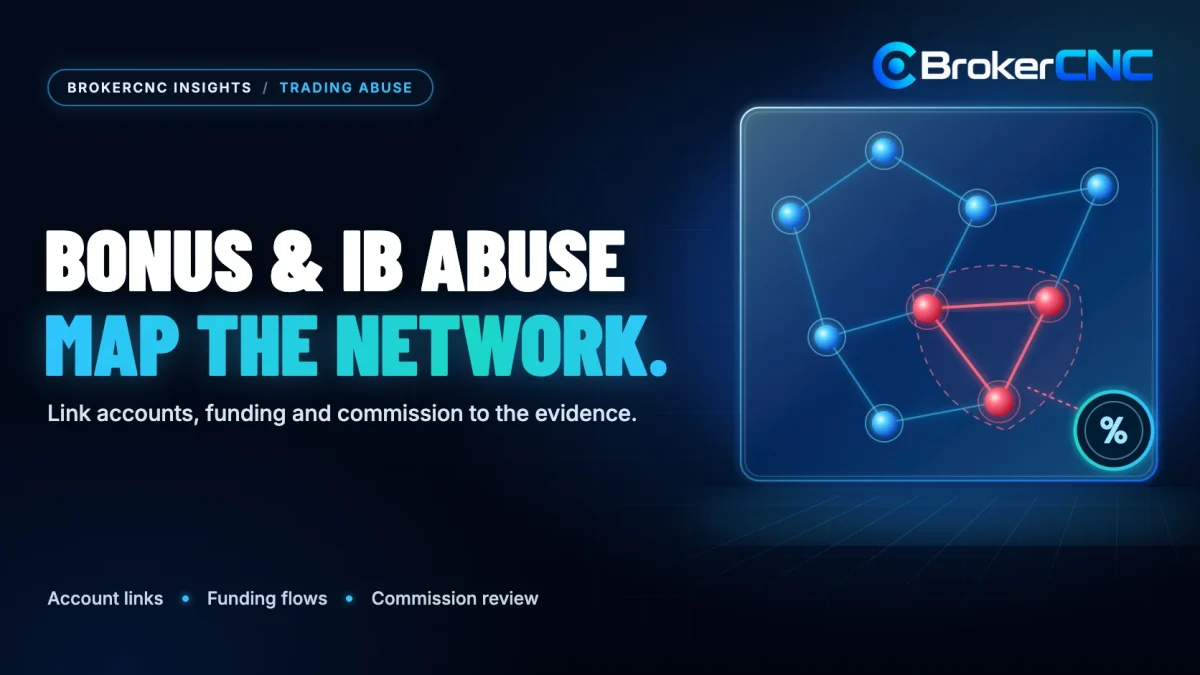
Bonus abuse and IB abuse are attempts to extract promotional credit, rebates or commission from a brokerage without the genuine client activity those programmes were designed to reward. Both usually depend on more than one account, which is why they are rarely visible when accounts are reviewed one at a time.
A large bonus withdrawal or an unusually active IB is not evidence of abuse on its own. The review has to show how accounts relate to each other, how funds and trades move between them and whether the result breaches the programme terms. This guide sets out the evidence to assemble before acting.
Start from the programme terms
Every investigation should begin with the rule that is allegedly being broken. Record which bonus or partnership terms applied at the time, including eligibility, trading-volume conditions, restrictions on hedging between accounts and any limit on accounts per person or household.
Terms that are vague or applied inconsistently make any outcome difficult to defend. If the review exposes a gap in the terms, record it separately so the policy can be tightened without retrospectively applying a rule that did not exist.
Map the relationships between accounts
Most schemes rely on several accounts that appear independent. Compare shared devices, IP addresses and network ranges, registration details, funding sources and access times. Treat each signal as context rather than proof: households, offices and shared networks can produce legitimate overlaps.
Group accounts only when several independent signals point the same way, and keep the evidence for each link reviewable. The linked-account investigation guide explains how to separate a strong relationship from a coincidence.
A shared IP address can mean coordinated accounts, or simply two clients using the same office network. Record what each link shows and what it does not.
Look for trading that exists only to meet conditions
Bonus abuse often appears as trading designed to satisfy volume requirements with little market risk: opposing positions across linked accounts, very short holding times in liquid instruments, or activity that stops as soon as a bonus or rebate becomes withdrawable.
For IB abuse, compare the commission or rebate generated with the trading behaviour behind it. Self-referred accounts, churned volume between related clients and activity that offsets across the referral network are patterns worth reviewing. Keep timing, instruments and position sizes visible so that genuinely active clients are not swept into the same conclusion.
Follow deposits, credits and withdrawals
Reconstruct the funding sequence for the group: deposits, bonus credits, internal transfers, profits and withdrawals. A typical concern is a pattern in which one account in a hedged pair loses its bonus-funded balance while the related account withdraws the gain.
Measure the group result, not just individual accounts. A single account may show a modest outcome while the network as a whole extracts promotional value or commission that the programme was never intended to pay.
Quantify the cost to the brokerage
Separate the components of the impact: bonus credit consumed, rebates or IB commission paid, trading P/L retained or lost on the B-Book, and any hedging or liquidity cost. Counting the same amount in two places overstates the case.
Record the sample, the time window and any data that is missing. If the estimate depends on an assumption, for example how a credit would have been used by a genuine client, state it so reviewers can test it.
Turn the review into a defensible decision
- Confirm the programme terms that applied at the time.
- Link accounts only with several independent, reviewable signals.
- Check whether trading exists mainly to satisfy bonus or rebate conditions.
- Reconstruct credits, transfers and withdrawals for the whole group.
- Record the decision, the owner and the evidence on both sides.
Distinguish an alert from a confirmed breach. Responses such as removing credit, adjusting IB payouts or restricting accounts should follow the brokerage’s documented process and the applicable terms. Record cases that were reviewed and closed without action, because they improve future thresholds.
The BrokerCNC Linked Account Detection module groups related accounts with the evidence behind each link and measures the network’s impact on deposits, withdrawals and book P/L. Pair it with the toxic trading guide when the same accounts also show execution-related patterns.
Common bonus and IB abuse questions
Is opening several accounts always bonus abuse?
No. Many brokers allow multiple accounts. It becomes a concern when the accounts are used together in a way the programme terms prohibit, such as hedging bonus-funded positions against each other.
Can IB abuse happen without the IB’s knowledge?
Yes. Clients can churn volume or hedge between accounts under a legitimate IB. The review should establish who controls the accounts before drawing conclusions about the partner.
See the workflow in BrokerCNC.
Discuss your MT4/MT5 servers, operating priorities and the evidence your team needs.
Book a Live Demo →