
A-Book and B-Book reporting should explain how the brokerage earned its result, not simply divide accounts into two lists. Routing, client charges, liquidity costs, rebates and changes in allocation all influence what the desk retains.
A useful broker revenue view reconciles those components to their underlying records. It also explains the perspective of each number: client market P/L is not the same thing as broker revenue.
Define the book model you actually operate
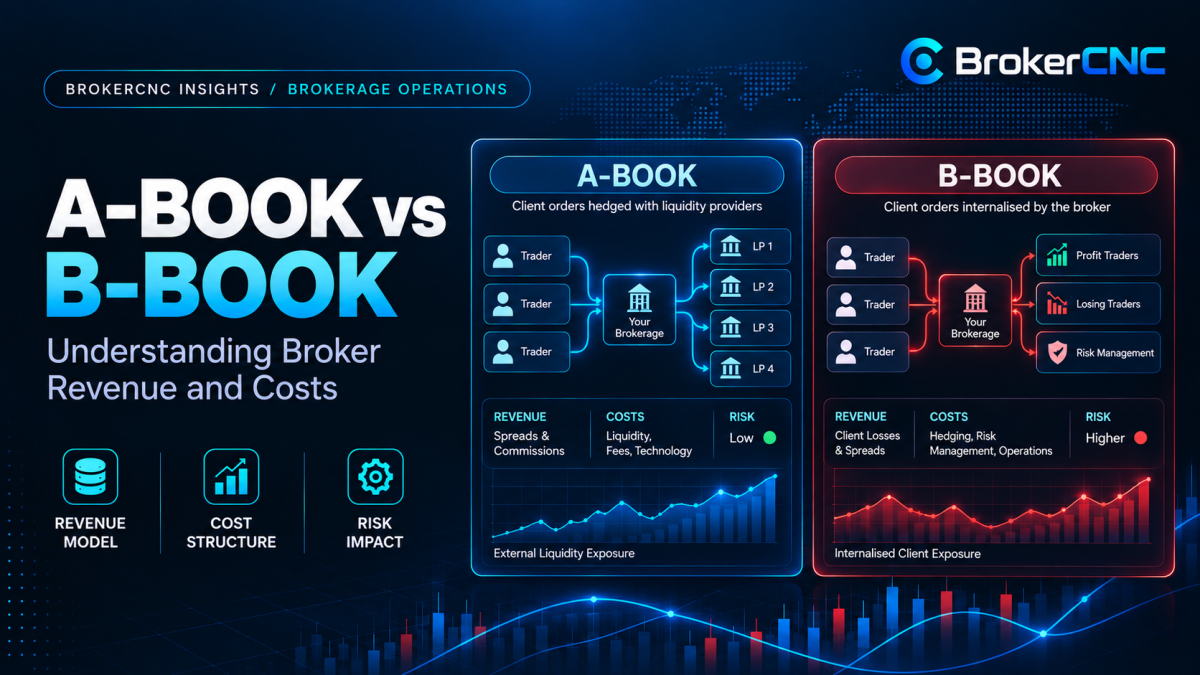
In a simplified A-Book model, the broker offsets client market exposure externally and earns from its commercial terms, less the costs of execution and servicing. In a simplified B-Book model, the broker retains some or all of the market exposure, so the retained trading result depends on the client’s market outcome as well as charges and costs.
Actual arrangements can be hybrid or partially hedged. An A-Book designation does not prove that every position was fully offset, and a B-Book designation does not mean that no hedge exists. Report the allocation and execution evidence that apply to the records being reviewed.
Build a component-based revenue bridge
Begin with clearly defined revenue and cost lines. Show client commissions, identifiable spread or markup revenue, swap differentials and retained market results separately. Deduct applicable liquidity charges, bridge charges and partner rebates according to the commercial arrangements.
State what the result excludes. A trading-desk contribution figure may exclude staff, licensing and wider operating expenses. Label it accordingly instead of presenting it as complete company profit.
- Choose a reporting currency and conversion basis.
- Keep realised results distinct from the mark on open positions.
- Separate measured charges from estimates derived from configured rates.
- Identify unmatched records and adjustments.
- Apply one consistent sign convention across revenue and costs.
Prevent double counting
Markup can be embedded in a price difference rather than posted as a separate cash item. Swap and commission fields can also be reflected in a wider result. Understand the source calculation before adding another line with the same economic effect.
For MT5 deals, MetaQuotes documents separate profit, commission, swap and fee properties. Those fields support analysis, but they do not establish the brokerage’s complete net revenue on their own. Review the official deal-property definitions when mapping your server records.
Make cost calculations transparent
Liquidity and bridge charges may depend on volume, instrument, route, period or commercial tier. Keep the configured rate, charge basis and effective dates available for review. Where a minimum monthly charge applies, a per-trade estimate may need a separate period-end adjustment.
A reporting period has $10,000 of identified revenue, $2,000 of liquidity charges, $500 of bridge charges and $1,500 of partner rebates. The contribution from those components is $6,000, before other expenses. This example assumes the four lines are mutually exclusive and contain no embedded duplicate charges.
Reconcile estimates against actual statements when those become available. If a required cost is unknown, flag the result as incomplete rather than silently assigning zero.
Preserve attribution when a position changes book
A position can remain open while its allocation changes. Assigning its entire final market P/L to the last book loses the history. A segment approach records the mark at each transfer and attributes the subsequent movement to the allocation active during that interval.
Suppose a client position reaches +$1,200 while in B-Book, then transfers to A-Book. Its market P/L rises to +$2,000 before returning to B-Book and closes at +$1,600. The client-perspective segments are +$1,200, +$800 and −$400. Under a simplified fully retained B-Book assumption, the retained market contribution across the first and last segments is −$800. Actual hedge results and charges must be reconciled separately.
Connect the server, bridge and desk records
Use trading-server records for the client side, bridge and liquidity records for external execution context, and configured commercial terms for applicable rates. Maintain a path from the total result to individual components and their source records.
BrokerCNC’s Broker Revenue demo shows the reconciliation concept. The Book Transfers demo illustrates why a transfer history matters to A-Book and B-Book attribution.
See the workflow in BrokerCNC.
Explore the product demo, then discuss your servers, routing and brokerage priorities with our team.
Book a Live Demo →